
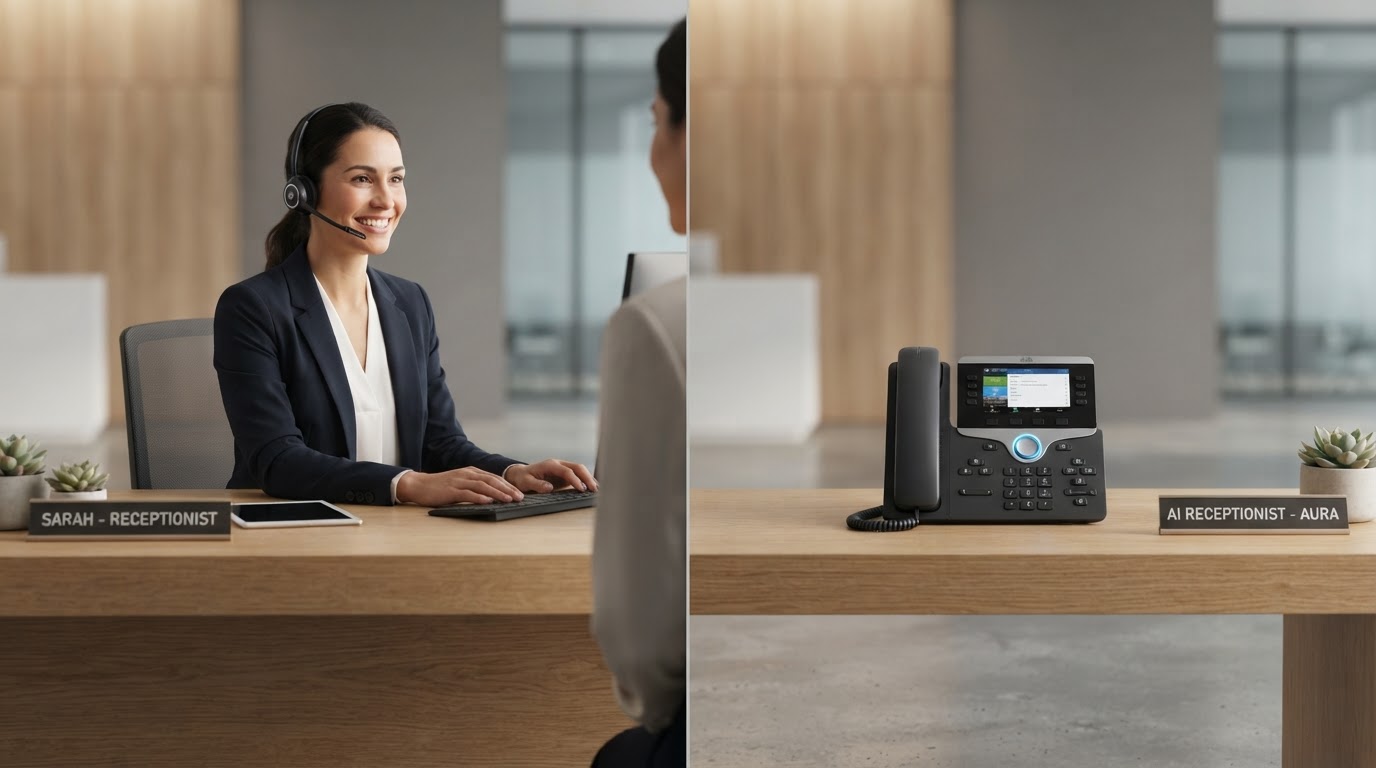
A law firm gets a call from a prospective client at seven in the evening. The virtual receptionist service has closed for the night, the call goes to voicemail, and the client rings the next firm. The same firm gets a call at lunchtime while the receptionist is on another line. The virtual service picks up, takes a message, and the firm rings back an hour later. The client has already booked a consultation elsewhere. The gap in both cases is not the person answering. It is the coverage and the speed.
Two approaches to the same problem
Professional service firms, whether law, accountancy or financial advice, face the same core challenge: the person who gives the advice is usually the person who cannot answer the phone. Both virtual receptionists and AI receptionists exist to bridge that gap. They go about it differently, and the differences matter.
What a virtual receptionist does well
A virtual receptionist is a real person, usually working from a call centre, who answers calls on behalf of your firm. They greet callers using your firm's name, take messages and forward urgent calls. The advantage is the human touch: a real voice, a real conversation, a real person who can reassure a nervous caller.
For firms whose clients value the personal relationship above all else, a human voice matters. A virtual receptionist can handle nuance that an AI may not, and some callers simply prefer speaking to a person.
Where a virtual receptionist falls short
- Coverage gaps. Most virtual receptionist services operate during business hours, with out of hours handled by voicemail or an expensive premium tier. The calls that arrive at seven in the evening still go unanswered.
- Message taking, not booking. A virtual receptionist typically takes a message and forwards it. They rarely book directly into your diary, so the enquiry still requires a callback before it becomes a consultation.
- Per call or per minute pricing. Costs scale with call volume, which is fine when calls are quiet and painful when they pick up.
- Queueing. During busy periods, callers wait on hold or are sent to voicemail by the service itself.
What an AI receptionist does well
An AI receptionist such as Hire-Lexi answers every call instantly, day or night, without queueing. It captures the caller's details, answers common questions using the information you configure, and books consultations directly into your calendar where your system allows it through a tested integration.
- True 24/7 coverage. The same handling at midnight as at midday. No closed sign, no voicemail for out of hours calls.
- Instant answers. No hold music, no message slip, no callback required for routine questions.
- Booking on the call. Appointments booked directly rather than messages taken for later.
- Fixed monthly cost. No per call charges, so busy periods do not spike the bill.
The honest limitation
Where the two approaches differ
Availability
Virtual receptionists typically cover business hours, with out of hours as a premium add on or not at all. AI receptionists cover all hours at no extra cost. For firms whose prospects research in the evening, that gap matters.
Cost
Virtual receptionist services charge per call or per minute, so costs rise with volume. AI receptionists charge a fixed monthly fee. Our cost guide covers the pricing structure in detail, but the short version is that AI is generally cheaper for firms with any meaningful call volume.
Call handling
A virtual receptionist takes a message and forwards it. An AI receptionist captures the enquiry, answers common questions and books the consultation on the call. The difference is between a callback queue and a booked appointment.
The human touch
This is where virtual receptionists win. A real person on the phone is reassuring for sensitive or complex enquiries, and some clients simply prefer it. An AI receptionist handles the routine; a human handles the nuance.
Want to hear how an AI receptionist handles a professional services enquiry? Hear Lexi take the call for your firm.
Which is right for your firm?
If your firm values the human touch above cost and coverage, a virtual receptionist may suit. If your firm loses calls to voicemail out of hours, pays too much per minute for call handling, or loses enquiries to slow callbacks, an AI receptionist is the better fit. Many firms use both: AI for out of hours and overflow, human for the calls that need one. If missed calls are the bigger problem, our guide to the cost of missed business calls sets out what those lost enquiries can be worth.
The comparison is not about which is universally better. It is about which solves the problem your firm actually has. We compared AI and human receptionists in more depth here, including where each one wins.
Frequently asked questions
Is a virtual receptionist better than an AI receptionist?
It depends on your firm. Virtual receptionists offer a human touch that some clients prefer, while AI receptionists offer lower cost, true 24/7 availability and instant answers without queues. Many firms use a combination: AI for out of hours and overflow, human for complex calls.
Can either one book consultations?
Both can, where your booking system allows it through a tested integration. The difference is that an AI receptionist can check live availability instantly, while a virtual receptionist typically takes a message and books later.
Which is cheaper?
AI receptionists are generally lower cost because they do not charge per minute or per call. Virtual receptionist services typically charge per call or per minute, which adds up quickly for busy firms.
Hear Lexi answer calls for your business
Book a free Hire-Lexi demo. We will show you how Lexi would answer your calls, follow your rules and book your appointments.
Related reading
AI Receptionist vs Hiring a Receptionist: UK Guide
A balanced comparison of an AI receptionist and a human receptionist for UK businesses, covering cost, coverage, booking and when a hybrid approach wins.
AI Receptionist vs Answering Service: UK Comparison
Compare AI receptionists and traditional call answering services on pricing, availability, appointment booking and business efficiency.

AI Receptionist Cost UK 2026 | From £149/month
Compare UK AI receptionist prices from £149 per month. Explore call answering, appointment booking and advanced automation with Hire-Lexi.